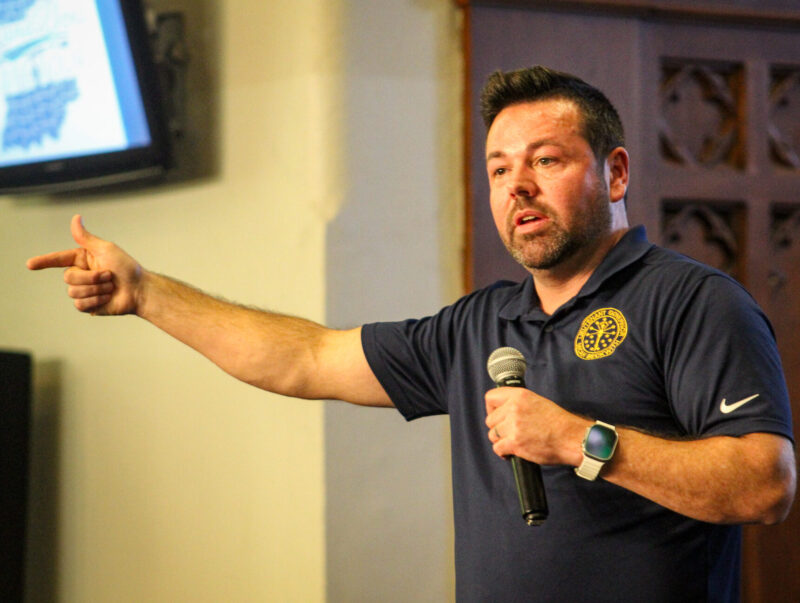
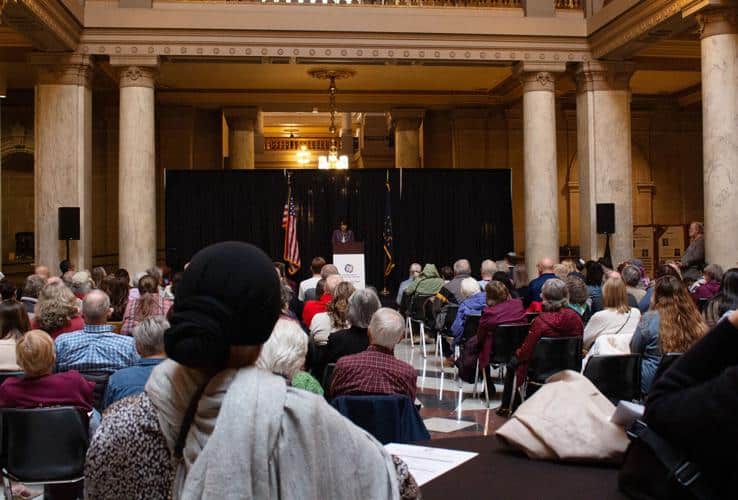
“Property tax relief that might result in the average Hoosier saving $26 in their taxes, maybe $100 or $200, in taxes, but it was the loss of tens of millions of dollars for individual school systems,” Gray said. “And meanwhile, those who own multi-million-dollar houses, they save $1,000s, $10,000, so we have to understand that this argument about tax cuts enriches the wealthy, impoverishes our communities, and gives the smallest benefit to the average Hoosier. …
“The charitable efforts of our churches and religious communities are never going to be able to make up for those gaps that this bad policy is creating.”
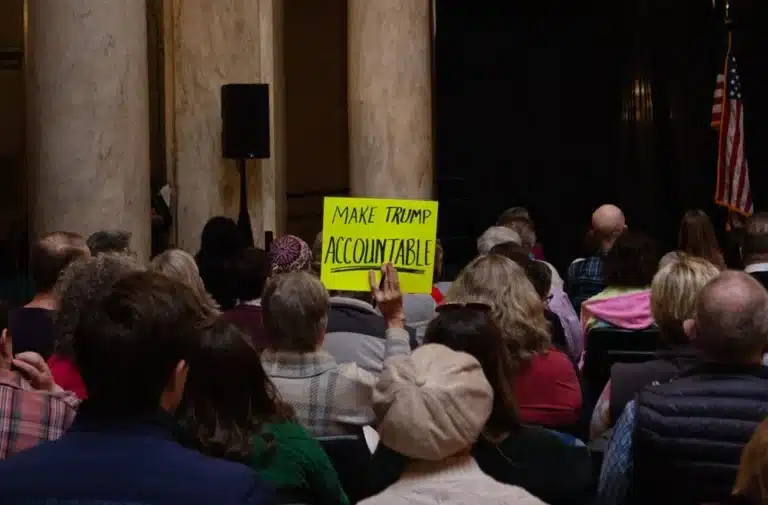
The demonstrators argued lawmakers are taking actions that make it harder for the poor and marginalized to use their voices and exercise their rights.
“If I’m so hungry because you have put off SNAP benefits to my family, it’s hard to express my voice. If you intentionally make it too difficult for Grandma to re-establish and re-apply for her health care, then it’s hard for her to pass down the wisdom and generation of years and years,” said Posley.
The IFVFJ is also concerned about Christian nationalism. Adam Friedman, the campaign director for Interfaith Alliance, said in a speech that 33% of Hoosiers are or sympathize with Christian nationalists. That number includes Lt. Gov. Micah Beckwith.
“That number affirms what can’t be captured by data, that feeling of proximity to neighbors, to co-workers, even lieutenant governors, who believe that one narrow interpretation of a religious tradition should be the law of the land,” said Friedman.
Spouses Melinda Swenson and Carol McCord, who attended the rally, could relate to this feeling. The couple lives in Bloomington, which they believe to be a more accepting place than other parts of Indiana. They came to the rally hoping to help make a change.
“It’s not about red and blue, it is about right and wrong,” said Swenson.
The two have been community faith members for 40 years and have participated in 12 social justice task forces. For them, fighting for others is a requirement of their faith.
“That’s the core of being human, is to be good to one another,” McCord said.
While the demonstrators do think that their religion calls them to be involved in politics, they are quick to point out that this reasoning does not mean they want religion to control any aspect of said politics.
“I don’t think the church should be involved [in] government,” said attendee Lacy Adams. “Government should be left alone, but we as church members individually should be advocating for appropriate policy and justice for other people.”