This column was originally published on the Ball State University Center for Business and Economic Research Weekly Commentary blog.
By Michael J. Hicks
January 4, 2026
Small towns are in for a sobering stretch of economic challenges as elected officials reverse pandemic-era policies that had been reviving them.
COVID-19 was a huge, unexpected opportunity for rural America. The pandemic brought jobs and people to places that had been in decline.
One reason is the pandemic brought a sharp shift in household consumption toward goods and away from services. Rural America, the manufacturing heartland, benefited from job growth in 2022 and 2023. That growth slowed by 2024, but legislation like Sen. Todd Young’s CHIPS Act offered at least a hint that we might be entering a period of more stable factory employment.
Unlike most of the world, the U.S. economy boomed after COVID. The effects were particularly obvious in labor markets, pushing us down to the longest stretch of sub-4% unemployment since the 1960s. This attracted immigrants — legal and illegal — many of whom came to rural America for economic opportunity.
This was a rare advantage for rural places with low quality of life. Economic migrants are driven more by good-paying jobs than luxuries such as walkable neighborhoods or nationally ranked schools. As was the case during the 19th and early-20th centuries, immigrants moved to places native-born Americans were fleeing.
Immigration became a once-in-a-century opportunity for rural places facing the deepest economic decline.
The pandemic also brought opportunities to rural places with high quality of life and small job markets. That’s because COVID accelerated remote work, severing the geographic ties between homes and offices and permitting families to choose rural communities while keeping their jobs.
New businesses also grew during the pandemic, bringing an excess supply of college-educated workers.
Meanwhile, rural America continued to benefit from tax policies, both federal and state. Rural Americans are older, poorer and face higher rates of disability. They pay less taxes and collect more benefits than their urban or suburban counterparts.
Indiana’s poorest rural county receives about $16,000 more per year in per-capita federal transfer payments than it pays. That same county receives $1,500 more per resident in state taxes than it pays.
Along with this, place-based economic policies favored rural counties. For example, child care tax credits, a popular state policy, did more to allow rural families to work than almost any other policy in the past half-century.
Taken together, these policies and economic realities offered rural America a brighter future. Today, everything I’ve just mentioned is at risk, or gone entirely.
The Trump administration has ended remote work for federal workers. Many states, including Indiana, have followed suit for state workers. That directly hurts rural America.
Tariffs and the trade war have reversed manufacturing employment and production. They are also eviscerating agricultural exports. Job growth effectively stopped in April. The deepest job losses are just now settling into rural America, with losses clustered in manufacturing, logistics and agriculture.
Immigration has also stopped, and with it the prospects of population growth for about two-thirds of rural counties. This loss of new families means employers won’t consider these places — they need workers. Schools will shrink, churches will lose congregants and decline will accelerate.
Federal funding will slow under the One Big Beautiful Bill Act. That’s unsurprising and inevitable given our large federal debt. But, despite what many believe, the geography of those cuts is dominated by rural places.
The deepest cuts come to Medicaid and other anti-poverty programs that see their heaviest use in rural places. This will lead to the closure of a number of rural hospitals across the country by 2030, as they rely so heavily on this support.
There’s little disagreement on the magnitude of these effects in Washington, D.C., and statehouses across the country. But rural Americans voted so overwhelmingly for the GOP that neither party has much incentive to address these problems.
And so, they will come to pass until the 1 in 5 Americans who live in rural places decide the current policy environment is robbing them of a prosperous future.
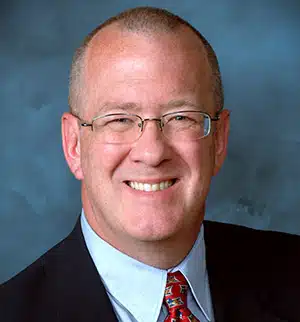
Michael J. Hicks is professor of economics and the director of the Center for Business and Economic Research at Ball State University. He previously served on the faculty of the Air Force Institute of Technology’s Graduate School of Engineering and Management and at research centers at Marshall University and the University of Tennessee. His research interest is in state and local public finance and the effect of public policy on the location, composition, and size of economic activity.
The views expressed here are solely those of the author, and do not represent those of funders, associations, any entity of Ball State University, or its governing body. Also, the views and opinions expressed do not necessarily reflect the views of The Indiana Citizen or any other affiliated organization.