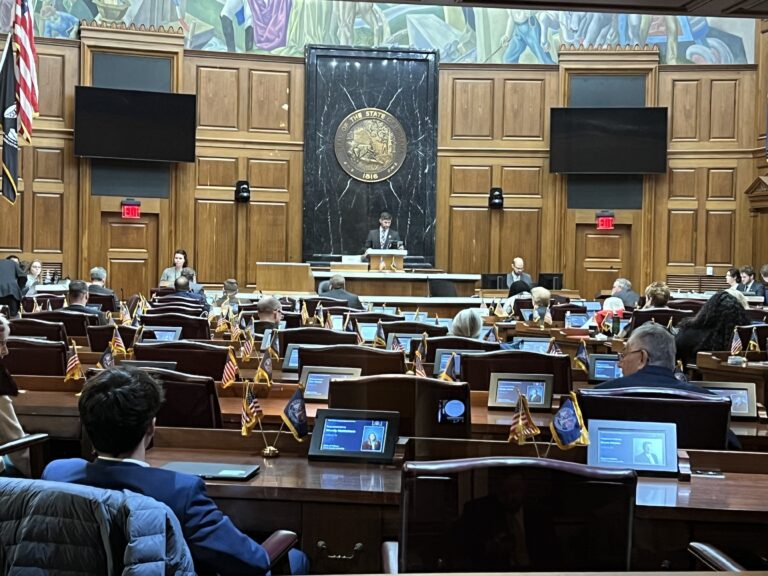
A tense, nearly six-hour meeting of the House Elections and Apportionment Committee took place in the House chamber Tuesday, resulting in a bill allowing early redistricting to move forward. (Photo/Sydney Byerly)
By Colleen Steffen
TheStatehouseFile.com
December 2, 2025
Over and over, critics of Indiana House Republicans’ proposed new congressional map were met with the same phrase from Rep. Ben Smaltz, R-Auburn, at Tuesday’s hours-long hearing of the House Elections and Apportionment Committee.
“We have drawn these maps to create a Republican political advantage.”
Smaltz authored House Bill 1032, which would allow lawmakers “to amend congressional districts at a time other than the first regular session of the general assembly convening immediately following the United States decennial census”—or, to redistrict the state ahead of the 2026 midterm election, a major goal of the Trump administration.
After nearly six hours of testimony, Smaltz’s bill would pass committee over the no votes of four Democrats and a single Republican, Rep. Tim Yocum, R-Clinton. The full House was then scheduled to take up the redistricting issue just 20 minutes later.
Racially gerrymandered maps?
Smaltz repeatedly told Democratic members of the committee that Republicans, when creating their map, had taken no other information into account than winning their party all nine of Indiana’s congressional seats. Most notably, he said they had disregarded the racial makeup of their proposed new voting districts, which drew incredulous ire from his colleagues across the aisle.
“So you’re OK with having racially gerrymandered maps because your priority is for political advantage?” asked Rep. Cherrish Pryor, D-Indianapolis. “In order to comply with the Voting Rights Act, why would you not look at the racial makeup of the districts?”
“That will be something the courts will decide, if we’ve done this appropriately,” Smaltz said.
In introducing his bill to the committee, Smaltz characterized his party’s redistricting efforts as consistent with the role the Founding Fathers envisioned for the states, as an appropriate response to movements taking place in other states like Texas and California, and as a necessity to preserve Republican power at the national level.
He also said a string of doxxing, bomb threats and swatting attempts aimed at apparent hold-outs in the legislature had not influenced his or his colleagues’ decision to push the redistricting effort forward—this despite the Senate earlier indicating it does not have the votes.
“Would you agree there’s pressure on the caucus?” asked Rep. Matt Pierce, D-Bloomington, who several times would request to schedule community hearings and be denied by the chair.
“That’s not going to change my mind,” Smaltz answered, saying he had spoken personally with both President Donald Trump and Vice President JD Vance and found them “very professional.” He also said he and his family had received death threats.
“It’s not an unusual part of the process,” he said.
Many testifiers took exception to that statement, as they objected to other aspects of Smaltz’s bill, including its limits on how the courts might be allowed to respond.
Democrats on the committee most focused on the map breaking apart minority communities—for example, in Marion County, split into four separate districts—and threatening the seat of Indiana’s sole African American representative, Andre Carson. They said the map could violate the 1965 Voting Rights Act.
“We did not look at any other information than what created a political advantage,” Smaltz replied.
Democrats questioned why district maps considered “almost perfect” four years ago are suddenly unacceptable and why Republican lawmakers are choosing to focus on redistricting rather than issues more pressing to everyday Hoosiers—for example, rising utility rates. They also quarreled with committee Chair Timothy Wesco, R-Osceola, about the time they were taking to press the bill’s author.
“Everything has been done in secret and at the last minute,” said Rep. Sue Errington, D-Muncie, which on the new map finds itself split from the rest of Delaware County and joined with communities on the Michigan border. “The public has been kept out of the conversation.”
Nevertheless, citizens of all stripes—teachers, veterans, retirees, poll workers, immigrants, members of the LGBTQ community—and representatives of many political organizations took turns at the podium for the next several hours, all but a few disagreeing with Smaltz that under his new map, “every vote counts.” Unlike at recent anti-redistricting rallies, opponents sat quietly in the galleries amid a tense atmosphere, no clapping or sign waving.
‘Hoosiers aren’t asking for this’
Marion County Circuit Court Clerk Kate Sweeney Bell described the “cascading domino effect” early redistricting would have on a complicated voting system involving thousands of people in her county, from updating computers to mailing cards to every single affected voter—and without additional funding.
She called splitting precincts, which the new map does, “an administrative burden like you wouldn’t believe” and said the stress on the system would sow distrust in the process.
“If it passes, there will be chaos,” Sweeney Bell said.
Sue Ellspermann, Republican lieutenant governor under former Gov. Mike Pence and later president of Ivy Tech Community College of Indiana, told the committee, “Hoosiers are not asking for this.”
She was one of a few people to mention the Democratic walkout of 2011 and the political consequences paid by its participants.
“Hoosiers will remember and may well hold you accountable,” she said.
Like Ellspermann, many called on Indiana Republicans to resist pressure from Washington, D.C.
“Hoosiers play fair,” said Megan Robertson of Indiana Conservation Voters. She noted that in the new map, the Statehouse building would fall in a different district than staff favorite Café Patachou across the street.
“The folks who drew these maps, who are apparently in Washington, D.C, and probably have never been to our state, may not know how ridiculous those two facts are, but the people who live here know it,” she said.
Julia Vaughn, executive director of Common Cause Indiana, said “a loud but small, very self-interested minority” was pandering to the president and ignoring the voices of Hoosiers.
“The only thing that is forcing this in Indiana is the Trump administration and national organizations who see Indiana voters as pawns in their political games,” said Vaughn. “We are not pawns, and our elections are not, and it is an insult to every Hoosier who believes in the democratic process.”
Barbara Tully of the League of Women Voters of Indiana implored lawmakers to stand up to outside influence. “Integrity still has a place in our democracy even in the face of intense pressure,” she said.
A citizen in a rainbow sweatshirt was perhaps more blunt when he clucked like a chicken at the Republicans sitting in the front row of the chamber.
Failed amendments
Also blunt was Rep. Robin Shackleford, D-Indianapolis, speaking during the public testimony phase of the meeting. She called Republican redistricting efforts a “Hitler-type plan of control.”
“The impact of this bill will be crippling to the Black and brown community,” she said.
Denise Abdul Rahman, speaking for the Indiana NAACP, called the bill racist.
“Racial gerrymandering is a foundational step in ensuring minority voters are left without representation and disenfranchised by a system that reports to be free and fair,” she said. “Racially gerrymandering districts have profound social effects, including reinforcing political disenfranchisement and perpetuating inequality by limiting access to resources like education, housing and health care. …
“Furthermore, these practices can create a political environment where legislators disregard the will of the people and pass discriminatory policies and social issues.”
Five amendments proposed by Democrats, seeking to tie redistricting more firmly to the census or to affordability issues or to require public hearings, all failed along party lines. Before the final vote, Pierce described his sense of sadness at the proceedings.
“What’s happening here is not normal,” he said.
Colleen Steffen is executive editor of TheStatehouseFile.com, a news site powered by Franklin College journalism students. She worked as a newspaper reporter and editor for more than 13 years and is now in her 10th year teaching college journalists.